


Multilayer PMMA Disc 98 × 16 mm for CAD/CAM Temporary Dental Restorations
Earn 37 loyalty points
Référence: HOML16A10
European delivery depending on destination
Secure payment by credit or debit card
Secure payment with PayPal
PayPal may offer Pay in 3 if the customer and purchase are eligible
Credit / debit card
PayPal
Bank transfer
* Instalment payment may be offered by PayPal subject to customer and purchase eligibility. Available options may vary depending on the PayPal account.
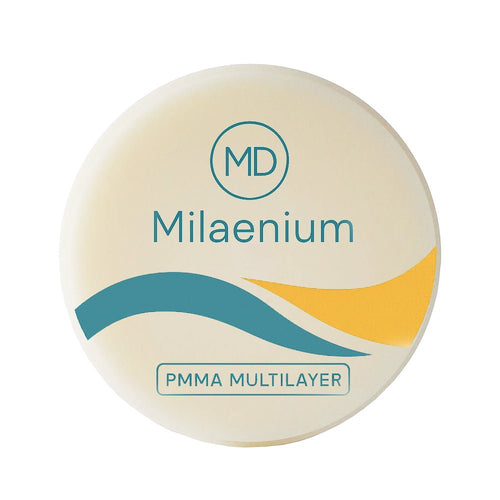
Multilayer PMMA Disc 98 × 16 mm – Multilayer CAD/CAM Temporary Resin
Brand:DLG
Range:Milaenium
SKU:HOML16A1
Format:Ø 98.5 mm × 16 mm
The 98 × 16 mm multilayer PMMA disc is designed for the fabrication of CAD/CAM temporary restorations in dental laboratories. Its compact format is particularly suitable for temporary crowns, short-span provisional bridges, and transitional restorations requiring a more natural appearance thanks to the Multilayer effect.
Multilayer PMMA Ø 98.5 mm 16 mm thickness CAD/CAM temporary Easy polishing Aesthetic result
Quick overview
This DLG Multilayer PMMA disc is intended for laboratories looking for a machinable temporary resin that is material-efficient and visually more refined than a single-layer PMMA. The 16 mm format is particularly relevant for single-unit work and small provisional restorations, with controlled milling time and fast finishing at the bench.
16 mm multilayer PMMA disc for CAD/CAM provisional restorations in dental laboratories
In a CAD/CAM dental laboratory workflow, the right PMMA disc must combine three essential criteria: stable machining, consistent aesthetics and controlled material cost. With its 98.5 mm × 16 mm format, this Milaenium Multilayers version is well suited to low- to medium-height temporary restorations, while facilitating polishing, sprue trimming and shade management directly after milling.
Laboratory applications
- Single-unit temporary crowns milled in CAD/CAM.
- Short-span provisional bridges for straightforward cases.
- Aesthetic transitional restorations before the definitive prosthesis.
- Validation provisionals for occlusal or functional assessment.
- Daily laboratory production on Ø 98.5 mm disc systems.
Key advantages
- Multilayer gradient for a more natural visual effect than a uniform PMMA disc.
- 16 mm thickness suited to standard temporary restorations.
- Fast milling with optimized material consumption.
- Easy polishing to save time during finishing.
- Standard 98.5 mm format compatible with many open systems.
Usage comparison
Why choose a 16 mm disc?
The 16 mm PMMA disc is often the best compromise for temporary crowns and small provisional bridges. It avoids unnecessary material consumption for restorations that do not require greater thickness, while reducing cost per unit and milling time.
When should you move to a greater thickness?
A thicker disc becomes more relevant for larger provisional work, taller anatomies or restorations requiring a greater material reserve. For standard laboratory cases, the 16 mm format very often remains the most rational choice.
Buying guide: how to choose your multilayer PMMA disc
- Check the disc diameter: your milling unit must accept the Ø 98.5 mm format.
- Select the thickness according to your indications: 16 mm is very well suited to standard provisionals.
- Choose the shade according to your workflow and the most frequent clinical requests.
- Prefer multilayer material if you want a more lively result without overloading the finishing stage.
- Anticipate the finishing workflow: a PMMA that mills well and polishes easily saves real time in the lab.
Laboratory compatibility
This Multilayer PMMA disc is designed for open CAD/CAM systems using the Ø 98.5 mm disc format. It integrates into milling workflows dedicated to the fabrication of temporary dental restorations. Before validation, it is still advisable to check the disc holder, the maximum accepted thickness and the PMMA milling strategy of your unit.
Installation and instructions for use
- Position the 98.5 mm PMMA disc in the compatible holder of the milling unit.
- Select a PMMA milling strategy suitable for provisional restorations.
- Orient the restoration to make intelligent use of the multilayer effect.
- Mill the restoration, then proceed with sprue trimming.
- Carry out adjustment and the final polishing to obtain a smooth, glossy surface.
Lab tip
To get the most out of multilayer PMMA, place the restoration in the disc while taking the cervical zone and the incisal/occlusal area into account. This positioning improves the visual rendering of the shade gradient and can limit aesthetic adjustments after milling.
Handling and storage in the laboratory
- Store the disc away from excessive heat and UV exposure.
- Keep it in its original packaging until the time of milling.
- Avoid impacts or unnecessary pressure on the edge of the disc.
- Store PMMA consumables in a clean and dry environment.
Technical specifications
| Product | Multilayer PMMA disc for dental laboratories |
|---|---|
| Brand | D.L.G |
| Range | Milaenium |
| SKU | HOML16A1 |
| Diameter | 98.5 mm |
| Thickness | 16 mm |
| Material | PMMA – polymethyl methacrylate |
| Type of use | Multilayer CAD/CAM temporary resin |
| Main indications | Temporary crowns and short-span provisional bridges |
| Compatibility | Open systems accepting Ø 98.5 mm discs |
| Reference shade | A - D Vita * |
Related products


Packaging & delivery
- Contents: 1 multilayer PMMA disc Ø 98.5 mm × 16 mm.
- Reference: HOML16A1.
- Brand / range: D.L.G/Milaenium.
- Use: CAD/CAM consumable for dental laboratories.
Frequently asked questions
What is a 98 × 16 mm Multilayer PMMA disc used for in a dental laboratory?
This disc is used for milling CAD/CAM provisional restorations such as single-unit crowns and certain short-span temporary bridges.
Its 16 mm format is well suited to standard provisional restorations with controlled production cost.
It makes it possible to produce restorations quickly with a much more natural result than a monocolor PMMA.
Why choose a multilayer PMMA rather than a monolayer PMMA?
Multilayer PMMA offers a more aesthetic gradient effect within the material itself.
This helps achieve a more lifelike provisional restoration after milling and polishing.
In the laboratory, this can reduce the need for aesthetic adjustments on certain straightforward cases.
Is the disc compatible with all dental milling machines?
It is intended for open systems compatible with Ø 98.5 mm discs.
You should always verify the disc holder, the accepted thickness and the material strategy available on your milling unit.
This verification helps avoid mounting errors or incompatibilities in the CAD/CAM workflow.
What is the specific advantage of 16 mm thickness?
The 16 mm thickness is particularly useful for standard provisional work.
It often helps reduce material waste while keeping milling cost more rational.
It is an efficient format for laboratories that regularly produce crowns and small temporary bridges.
How can the aesthetic result be improved after milling?
It is recommended to position the restoration in the disc while taking the multilayer stratification into account.
After milling, careful sprue trimming followed by progressive polishing helps obtain a more homogeneous and glossier surface.
This combination enhances the aesthetic effect of Multilayers PMMA more effectively.
Conclusion
The DLG/Milaenium Multilayer PMMA disc 98 × 16 mm is a relevant solution for laboratories seeking a CAD/CAM temporary resin focused on productivity, aesthetics and cost control.
Its 16 mm format, standard 98.5 mm diameter and multilayer effect make it a consistent choice for strengthening a reliable CAD/CAM workflow for everyday temporary restorations.
*Vita is a registered trademark
 Multilayer PMMA Disc 98 × 16 mm for CAD/CAM Temporary Dental Restorations