


UGN DENTAIRE e.ON Sinter Fast+ Zirconia Sintering Furnace
Référence: FCE01SIN0006

UGIN DENTAIRE e.ON sinter fast + zirconia sintering furnace / fast cycles & high-precision control
The e.ON sinter fast + is a zirconia sintering furnace designed to run both conventional cycles and very short cycles, with 1-hour sintering depending on the zirconia used and the protocol validated by the laboratory.
Its 7″ touchscreen interface, graphical cycle display and precise step control make it a reliable production tool for laboratories handling routine batches, urgent single-unit cases and CAD/CAM workflow organization.
A furnace designed for production… and urgent cases
In the laboratory, zirconia sintering must address two realities: producing high volumes with conventional cycles and producing quickly when a clinical priority arises. The e.ON sinter fast + was designed to cover both needs, with a clear program logic and graphical cycle tracking.
The supplied sintering trays and zirconia beads help provide consistent restoration support, while making loading organization easier and improving stability during temperature ramp-up.
Lab tip: create one reference program for each zirconia brand you use daily, then derive “fast” and “conventional” variants from this internally validated baseline.
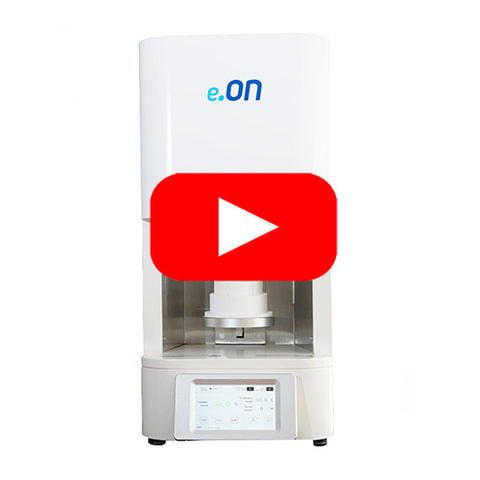
Presentation video
See the furnace in action in a production environment: program logic, fast-cycle workflow and equipment presentation in a dental laboratory setting.
▶︎ Watch the e.ON sinter fast + video (YouTube)
Tip: always validate a fast cycle with a test piece before using it for a clinical batch.
Fast production (up to 1 hour depending on zirconia)
Ideal when you need to deliver a limited number of restorations quickly in the laboratory, while maintaining a structured and repeatable cycle logic.
- Time savings for priority work and urgent adjustments.
- Controlled loading with a stated capacity of up to 20 restorations in fast-cycle mode.
- Readable curves thanks to the integrated graphical display.
Fast-cycle compatibility always depends on the zirconia brand and the recommendations of the disc manufacturer.
Conventional cycle (batches and heavy loads)
Recommended for large volumes or when you require maximum stability across zirconia restoration batches.
- Stated capacity of up to 40 restorations in conventional mode.
- Detailed programming with 40 custom programs and up to 40 steps per program.
- Repeatability through ±1 °C accuracy, MoSi₂ heating and Pt/Rh thermocouple technology.
For highly translucent zirconias or the most demanding indications, a conventional manufacturer-recommended cycle often remains the safest option.
Technical data — clear summary
| Screen | 7″ high-definition color touchscreen (approx. 155 × 87 mm) |
|---|---|
| Maximum temperature | 1730 °C |
| Operating temperature | Below 1650 °C |
| Temperature accuracy | ±1 °C |
| Cycle time | From one to several hours depending on zirconia and protocol |
| Heating elements | 4 MoSi₂ elements (pins), molybdenum disilicide |
| Thermocouple | Dual platinum / rhodium flat thermocouple (Pt/Rh) |
| Programs | 40 custom programs, up to 40 possible steps per program |
| Display | Graphical cycle display |
| Accessories | 2 trays + lids + zirconia beads |
| Stated capacity | Up to 40 restorations in conventional mode / up to 20 restorations in fast mode |
| Display languages | French, English, Italian, Spanish |
| Chamber | 110 × 120 mm |
| Dimensions (H × W × D) | 830 × 420 × 600 mm |
| Weight | 74 kg |
| Maximum power | 3 kW |
| Supply voltage | 230 V (50/60 Hz) |
What makes the difference in zirconia sintering
Beyond maximum temperature, a sintering furnace is judged by its ability to deliver consistent results: thermal stability, accurate step control, reliable measurement and well-organized loading over time.
Fine cycle control
Custom programs and the ability to use multiple steps allow the cycle to be adjusted to zirconia manufacturers’ recommendations, while keeping a clear workflow in the laboratory.
Graphical monitoring
The graphical display gives an immediate view of ramp-up, holding times and cooling. It is a real advantage for standardizing procedures between operators.
Heating & measurement
MoSi₂ elements and a Pt/Rh thermocouple are typically associated with high-temperature furnaces designed for serious, repeatable production in dental laboratories.
Process & quality — standardize your sintering workflow
To secure your results, the goal is to turn your firing cycles into a process: consistent loading rules, validated cycles and regular inspection of consumables such as trays and zirconia beads.
Validate one reference conventional cycle for each zirconia brand. It will serve as the baseline to compare appearance, densification and dimensional stability over time.
Set simple rules: even distribution, consistent spacing, use of clean zirconia beads and trays in good condition for regular heat circulation.
Monitor cycle consistency, the condition of the MoSi₂ elements and the stability of measurement through the Pt/Rh thermocouple. Any drift should lead to requalification.
A fast furnace performs best when the laboratory maintains validated cycle references and consistent loading.
Installation & requirements — key points
According to the manufacturer’s data, the furnace operates on 230 V (50/60 Hz) with a maximum power of 3 kW. Installation planning should take into account the footprint, loading access and day-to-day operating comfort.
- Electrical supply: 230 V power supply compatible with the laboratory installation.
- Power: dedicated line consistent with the stated maximum power of 3 kW.
- Space: comfortable access to the chamber and the 7″ touchscreen.
- Procedure: commissioning and cycle setup should follow zirconia manufacturers’ recommendations and your internal workflow.
Related products
For a consistent zirconia workstation setup, these references are frequently associated with sintering and cycle management in the laboratory.


Delivery
Contents: UGIN DENTAIRE e.ON sinter fast + sintering furnace supplied with 2 trays, lids and zirconia beads, according to the manufacturer’s standard package.
Requirements: 230 V power supply (50/60 Hz) and stated maximum power of 3 kW.
FAQ — UGIN DENTAIRE e.ON sinter fast +
When should a fast cycle of around 1 hour be used in the laboratory?
A fast cycle is relevant for small loads, single restorations or limited batches when the zirconia used is validated by its manufacturer for accelerated sintering kinetics.
In this context, the time saving is real for the laboratory, provided that production remains disciplined: proper spacing of restorations, clean sintering support, zirconia beads in good condition and an internally validated program.
For larger cases, long-span bridges, heavy loads or more demanding materials, a conventional cycle is often the safer option to secure densification, shrinkage control and the final result.
How can reliable repeatability of sintering cycles be achieved?
The best method is to work with one reference cycle defined for each zirconia type, then standardize the entire chain: same tray, same support configuration, same loading logic, same number of restorations and the same placement habits.
The e.ON sinter fast + makes this easier by storing programs and relying on graphical curve reading, which simplifies quick checks from one operator to another.
If differences in shade, surface appearance or shrinkage occur, the first step is to return to the reference protocol before questioning the material itself.
Which points should be monitored to keep results stable over time?
The stability of a sintering furnace does not depend on the program alone. You must also monitor the condition of the trays, the cleanliness and renewal of the zirconia beads, and overall cycle consistency over time.
On this type of equipment, the MoSi₂ heating elements and the Pt/Rh thermocouple are essential components. Thermal drift, less regular ramp-up or more variable results should be treated as warning signs.
For a laboratory working routinely, periodic verification with a control cycle is a good practice to secure production.
Is the furnace suitable for all dental zirconias on the market?
The furnace is designed to meet the common needs of dental zirconia sintering, including fast-cycle workflows. In practice, it can suit a wide range of materials, but it should never be generalized without verification.
Each zirconia manufacturer defines its own recommendations for temperature, hold time and duration. Actual compatibility therefore depends on the prescribed firing curve and on the validation carried out by the laboratory on its usual references.
The right approach is to validate each material with its dedicated protocol and then keep that program as the production reference.
Why use zirconia beads during sintering?
Zirconia beads are used to support restorations during the cycle while limiting stress points and excessive contact with the support surface.
They also contribute to a more homogeneous load distribution inside the tray, which helps secure dimensional stability for delicate or thin restorations.
In the laboratory, their benefit depends heavily on their actual condition: contaminated, worn or poorly maintained beads can, on the contrary, reduce result consistency. Their renewal is therefore part of good practice.
Why is graphical cycle visualization useful on a daily basis?
Graphical visualization is valuable because it allows the operator to quickly check whether the cycle actually performed matches the expected protocol. It is a real asset for laboratories aiming for reproducible production.
In case of deviation, it helps identify an anomaly in ramp-up, holding time or overall furnace behavior more quickly. It is therefore both a convenience feature, a control tool and a quality assurance aid.
In a multi-operator organization, this type of visual reading makes internal validation easier and more reliable.
 UGN DENTAIRE e.ON Sinter Fast+ Zirconia Sintering Furnace