


Ugin Dentaire e.ON 250 Neo Dental Ceramic & Pressing Furnace
Référence: FCE01EON0005

UGIN DENTAIRE e.ON 250 Neo Ceramic & Press Furnace — Neo range, laboratory performance
The e.ON 250 Neo combines ceramic firing and pressing in a design built for repeatability: touchscreen interface, operating diagnostics, controlled thermal inertia, and protocol traceability via USB.
It meets the requirements of today’s ceramics and modern production workflows: clearer cycles, structured favorites, and adjustable pressing modes (fixed, delayed, staged).
A premium furnace for modern ceramics
The e.ON 250 neo (firing & pressing) and e.ON 200 neo (firing) furnaces combine a range of technological innovations designed to meet the demands of current ceramic materials.
The goal in the laboratory is to reduce the gap between chamber temperature and restoration temperature, make cycles easier to read through graph curves, and secure workflow organization with favorites and backup functions.
Lab tip: build a library of favorites by indication type (firing / SP / pressing) and archive regularly via USB for simple, reliable traceability.
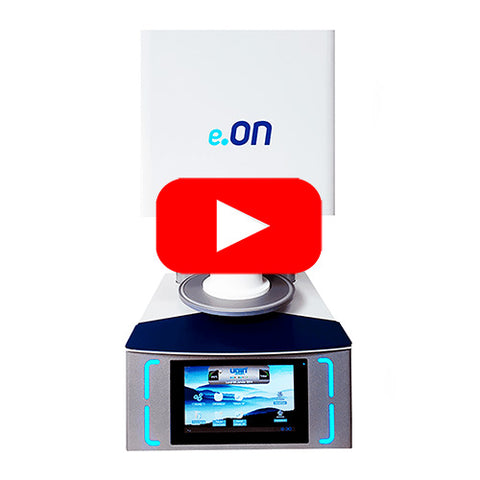
Presentation video
Discover the touchscreen interface, programming logic, and the “control + graph curves” approach of the Neo range.
▶︎ Watch the e.ON 250 Neo video (YouTube)
Tip: a test cycle with graphical monitoring helps validate ramp / holding stage consistency before standardization.
Quick comparison — e.ON 200 Neo vs e.ON 250 Neo
Both models belong to the Neo range and share the same “interface + control + stability” philosophy. The key difference is the pressing function.
e.ON 200 Neo
- Ceramic firing (layered ceramics / lab protocols).
- Touchscreen interface, graphical monitoring, automatic calibration, USB functions (according to range documentation).
- A relevant choice if your workflow is 100% firing.
e.ON 250 Neo
- Firing + Pressing (3 modes: fixed / delayed / staged).
- Pneumatic injection + multi-point injection, triple-body compression chamber.
- A relevant choice if you want to expand your laboratory into ceramic pressing.
For commissioning and exact functions by model, the manufacturer’s documentation remains the reference.
Key innovations (manufacturer)
A technical package designed for reliability, diagnostics, and thermal consistency throughout firing cycles.
- 7″ high-definition color touchscreen.
- Detection and display of operating faults.
- Fiber refractory insulation: controlled thermal inertia, reduced chamber/restoration temperature gap.
- Pneumatic injection (reliability).
- Triple-body compression chamber (regulation).
- Pressing: fixed, delayed or staged (for lithium disilicates).
- Multi-point injection.
- Possible injection of all ceramic types.
Technical features (manufacturer)
A very large program base, structured with favorites, plus graphical monitoring and USB export.
- 100 ceramic firing programs + 100 linked favorite programs.
- 100 special ceramic firing (SP) programs + 100 linked favorite programs.
- 50 ceramic pressing programs + 50 linked favorite programs.
- Control & monitoring via dual-display color graph.
- Calibration: automatic program.
- USB: data backup and transfer.
- Display: 6 languages (FR, EN, DE, IT, ES, RU).
Technical sheet — clear summary
| Display | 7″ high-definition color touchscreen |
|---|---|
| Firing programs | 100 ceramic firing + 100 linked favorites |
| SP firing programs | 100 special ceramic firing (SP) + 100 linked favorites |
| Pressing programs | 50 ceramic pressing + 50 linked favorites |
| Pressing modes | Fixed, delayed or staged (for lithium disilicates) |
| Control / monitoring | Dual-display color graph + fault detection/display |
| Calibration | Automatic calibration program |
| Backup / transfer | USB |
| Dimensions (H × W × D) | 719 × 320 × 360 mm |
| Weight | 27 kg |
| Power supply | 230 V (50/60 Hz) |
| Maximum power | 1850 W |
| Pressing pneumatic pressure | 1.7 to 6 bar |
| Display languages | French, English, German, Italian, Spanish, Russian |
What makes the difference in a high-end furnace
A premium furnace is not judged only by its maximum temperature, but by its ability to deliver repeatable and documentable results every day.
Thermal stability
Fiber refractory insulation is designed to better control inertia, helping reduce differences between chamber and restorations. Result: more consistent cycles and more stable esthetics.
Readability & control
Color graphical monitoring and fault detection provide useful visual control in production: the cycle becomes easier to understand and the routine becomes safer.
Adaptable pressing
Three modes (fixed, delayed, staged) make it possible to adapt pressing logic to materials and laboratory protocols, including lithium disilicates.
Process & Quality — standardization, internal control, traceability
For a premium furnace to deliver its full value, the laboratory must turn settings into a true process: validated cycles, structured favorites, and regular archiving.
Creating a reference cycle makes it possible to compare results over time (shade, maturation, gloss) and detect deviations more quickly.
Organizing favorites by cycle type (firing, SP, pressing) and by internal indication makes production more stable, especially with several operators.
Performing regular USB backups helps archive protocol versions and quickly replicate a validated configuration.
Dual-display color graph monitoring makes visual cycle checking easier and helps document daily quality routines.
Installation & commissioning — key requirements
Manufacturer data indicates a 230 V (50/60 Hz) power supply and a maximum power of 1850 W. For the pressing function, the system uses pneumatic injection: compressed air set between 1.7 and 6 bar is required.
- Electrical supply: provide a 230 V supply compatible with the laboratory installation.
- Pneumatics: 1.7–6 bar compressed air for pressing (depending on configuration).
- Calibration: the furnace includes an automatic calibration program to be integrated into your internal routine.
- Interface: 6 display languages for easier team use.
Detailed commissioning, settings and programming must be carried out according to the official user manual.
Related products
For a complete setup and a consistent workflow, these references are frequently associated with the furnace.


User manual & documentation
Access the official procedures: commissioning, calibration, programming, firing/pressing cycles and recommendations for use.
Delivery
Contents: UGIN DENTAIRE e.ON 250 Neo furnace (firing & pressing) + standard manufacturer accessories.
Requirements: 230 V power supply (50/60 Hz) and compressed air for pressing 1.7 to 6 bar.
Please note: depending on configuration, the vacuum pump may be offered separately.
FAQ — UGIN DENTAIRE e.ON 250 Neo
Why are there three pressing modes: fixed, delayed and staged?
The manufacturer provides three modes in order to adapt pressing to the material and protocol. The staged mode is specifically mentioned as suitable for lithium disilicates.
In day-to-day laboratory practice, this flexibility makes it possible to adjust the pressing logic to the indication while keeping programming stable and fully documentable through favorites.
How can you create a simple “quality” record using favorites and USB?
A robust method is to define a reference cycle, save favorites by indication, and then perform regular USB backups.
This gives you simple protocol-version traceability, useful for result consistency, internal training, and quick recovery of a validated configuration.
What requirements are essential for using the pressing function?
Pressing is based on pneumatic injection, so you must have compressed air adjustable between 1.7 and 6 bar.
The furnace operates on 230 V (50/60 Hz) and includes an automatic calibration program. For detailed commissioning, the official user manual remains the reference.
 Ugin Dentaire e.ON 250 Neo Dental Ceramic & Pressing Furnace