

 GipEx Tabs flocculant for sedimentation tank


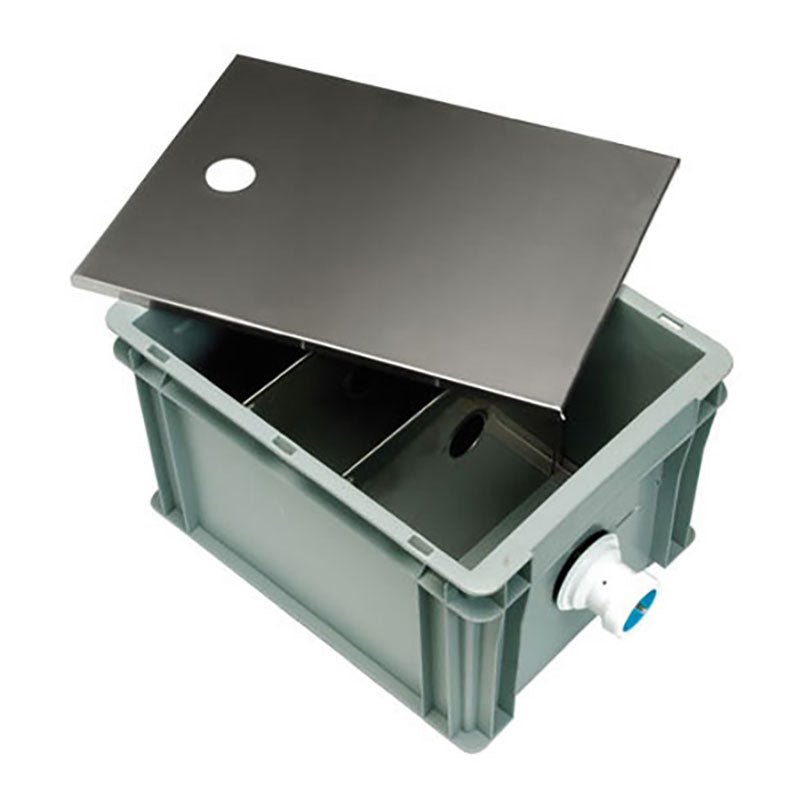
Dental settling tank 14 L Jeb – stainless steel lid (under-sink)
Earn 179 loyalty points
Référence: H92171
European delivery depending on destination
Secure payment by credit or debit card
Secure payment with PayPal
PayPal may offer Pay in 3 if the customer and purchase are eligible
Credit / debit card
PayPal
Bank transfer
* Instalment payment may be offered by PayPal subject to customer and purchase eligibility. Available options may vary depending on the PayPal account.
Wastewater management equipment
Economical 14 L sedimentation tank with stainless steel lid
This 14-litre sedimentation tank helps the dental laboratory better manage wastewater loaded with plaster, ceramic and other heavy particles.
It promotes simple gravity sedimentation before discharge into the drainage system.
Its design with removable partitions makes routine maintenance of the wet workstation easier.
14 litres Under sink Stainless steel lid 3 removable partitions
Quick summary
Practical sedimentation Simple solution to retain sludge and heavy particles before discharge.
Compact format 14 L capacity suitable for the wet workstations of many laboratories.
Easier maintenance The removable partitions simplify cleaning inside the tank.
Daily use Helps protect the drainage network against gradual clogging.
Why choose this sedimentation tank for a dental laboratory?
In a dental laboratory, wastewater can quickly carry residues of plaster, investment material, filings or fine mineral matter.
This economical sedimentation tank provides a simple technical solution to slow the passage of these particles and improve separation before discharge.
Its compact size is well suited to an under-sink installation, while the stainless steel lid offers a cleaner and more durable finish in the laboratory environment.
For facilities looking for an accessible, functional and easy-to-maintain solution, this model represents a very good balance between space requirement, sedimentation efficiency and ease of use.
Discover our different sedimentation tank models
This type of sedimentation tank is particularly recommended for laboratories using a plaster trimmer intensively or carrying out operations that generate large amounts of mineral sludge.
This Jeb under-sink sedimentation tank is an economical alternative to Mestra-type sedimentation tanks.
Laboratory applications
This sedimentation tank is particularly useful at workstations where water carries solid residues likely to clog pipework.
- Work with dental plaster and model bases.
- Cleaning equipment after modelling or investment procedures.
- Rinsing stations linked to polishing or materials such as plaster.
- Daily wastewater management under a technical laboratory sink.
Instructions for use
Install the tank under the sink between the outlet and the drainage system.
Connect the inlet and outlet to the specified Ø 40 mm diameter.
Check the tightness of the whole assembly before use.
Allow the particles to settle naturally in the internal compartments.
Open the tank at regular intervals to remove deposits and rinse the partitions.
Compatibility and integration
This model is designed for installation on a standard Ø 40 mm drainage system.
It is suitable for laboratories that want to add a pre-sedimentation step without setting up a complex system.
Its format makes it easier to integrate under a technical sink, provided there is sufficient clearance in width, depth and height.
Installation advice
Before ordering, it is advisable to check the space available under the cabinet or sink.
You should also allow practical access to the lid for inspection and cleaning operations.
A clean, stable and easily accessible installation improves service life and simplifies routine maintenance.
Care and maintenance
The tank should be checked regularly to avoid excessive accumulation of sludge and compact deposits.
The three removable partitions make internal dismantling easier for more thorough rinsing.
Periodic maintenance reduces the risk of odours, blockages and loss of sedimentation efficiency.
Lab tip
To further improve the separation of fine matter, the use of a flocculant for sedimentation tanks may be useful depending on the laboratory’s workload.
This approach helps bring suspended particles together and can make tank cleaning and sludge management easier.
Read our article about the benefits of using a sedimentation tank
Technical specifications
| Product | Economical sedimentation tank with stainless steel lid |
| Capacity | 14 litres |
| Dimensions (L × W × H) |
40 × 24 × 30 cm |
| Connection | Ø 40 mm |
| Materials | Plastic tank and stainless steel lid |
| Compartments | 3 removable partitions |
| Installation | Under-sink installation |
| Brand | Jeb |
| Reference / SKU | H92171 |
| Packaging | 1 sedimentation tank with lid |
How to choose a sedimentation tank?
The choice mainly depends on the volume of loaded wastewater treated each day, the space available under the sink, and the acceptable cleaning frequency within the laboratory organisation.
A 14-litre model is often relevant for regular use with a good balance between footprint and capacity.
For heavier requirements or more intensively used workstations, a larger volume may be more comfortable in order to reduce the frequency of maintenance operations.
Documents & resources
Advice before installation Check the available clearance under the sink, the connection diameter and accessibility for maintenance.
Recommended maintenance Schedule regular visual inspections to remove deposits before the tank becomes saturated.
Useful accessories The use of a flocculant and protective equipment can improve maintenance comfort.
Recommended related products
GipEx Tabs flocculant for sedimentation tank  Powder-free nitrile gloves
  Dentafloc for sedimentation tanks
 Other sedimentation tanks
Depending on the laboratory configuration and workload, it may be useful to choose another tank size.
- Mestra 14 L sedimentation tank with bag
- Mestra 19 L sedimentation tank with bag
- Mestra stainless steel sedimentation tank
- IMPORTANT: a sedimentation tank does not work for oil, grease, paint, wood dust, or any particles that do not sink.
Delivery
The delivery includes one economical 14 L sedimentation tank with its stainless steel lid.
The accessories shown in the related blocks are offered separately depending on the desired laboratory setup.
FAQ — sedimentation tank for dental laboratory
Where should this sedimentation tank be installed?
This model is generally installed under the laboratory sink, between the water outlet and the drainage system.
You should check the available space, usable height and connection diameter before installation.
What is the purpose of a sedimentation tank in a dental laboratory?
It is used to retain part of the solid residues present in wastewater, especially heavy particles from plaster, heavy filings or other mineral materials.
This pre-sedimentation helps limit clogging in the pipework and improves wet workstation management.
How often should it be cleaned?
The frequency depends on how intensively the laboratory uses it and on the amount of deposits generated each week.
Regular visual inspection is recommended so action can be taken before excessive accumulation builds up in the compartments.
Is a flocculant mandatory?
A flocculant is not systematically mandatory.
However, it can be very useful for accelerating the agglomeration of fine particles and improving sedimentation in certain working conditions.
Is this tank suitable for all dental laboratories?
It is suitable for many laboratories looking for a simple and compact solution for managing loaded wastewater.
However, it remains important to validate compatibility with the under-sink space, the operating flow and local requirements regarding equipment and drainage.
Does this tank replace verification of local regulations?
No.
This product is a suitable technical solution for improving pre-sedimentation of effluents, but final compliance must always be assessed according to the local rules applicable to the laboratory.
 Dental settling tank 14 L Jeb – stainless steel lid (under-sink)