


Artis Neo Dental Ceramic Furnace — High & Low Fusion
Référence: FCE01ATS0002

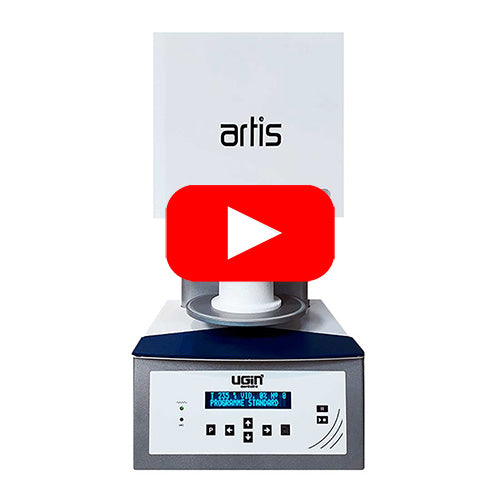
Artis Neo Ceramic Furnace — High & Low Fusion
A professional dental ceramic furnace for high- and low-fusing porcelains, combining robust build, ergonomic workflow, and optimized infrared energy transfer (≈2.5–2.7 µm) for outstanding firing quality.
Homogeneous heat deep within ceramic layers.
Low thermal inertia → optimized daily throughput.
Maximum optical permeability and heat uniformity.
Simple and reproducible protocol management.
Overview
The Artis Neo is engineered for precise dental ceramic firing, from minor corrections to full porcelain stratification, providing consistent results for demanding aesthetic cases.
- High power-density heating element: efficient infrared transfer (≈2.5–2.7 µm).
- Fibrous insulation with low thermal inertia: shorter heat-up and cool-down phases.
- Optimized firing base: reduced heat accumulation and improved cycle stability.
- Robust chassis and ergonomic design: easy integration into daily lab workflow.
- Thin quartz tube for maximum optical transmission and consistent firing uniformity.
Key benefits
- Optimized infrared: homogeneous firing, regular glaze, reduced internal stress.
- Thin quartz tube: high optical transmission and improved thermal uniformity.
- Productivity: shorter cycles with controlled energy consumption.
- Reproducibility: stable results from cycle to cycle (ideal for QC protocols).
- Multilingual interface: FR, EN, DE, IT, ES.
Designed to deliver clean vitrified surfaces, controlled shrinkage and thermal stability for daily production.
Complementary products


Lab recommendations
- Install on a stable, flat surface with clear rear ventilation space.
- Check the probe and perform periodic calibration according to your QC protocol.
- Adjust heating/holding/cooling ramps to each ceramic manufacturer’s technical data.
- Use compatible firing supports and avoid platform overload.
- Document validated cycles to ensure maximum repeatability in daily production.
Operating procedure
- Receiving & inspection: check chassis, accessories (tray, base) and cables.
- Installation: ventilated area, wall clearance ≥ 10 cm, protected dedicated 230 V line.
- First start: set language and time; check vacuum if the pump (option) is connected.
- Empty thermal test: run a quick ramp (e.g., 200 → 900 °C) to verify stability.
- Probe calibration: follow the manufacturer procedure and adjust offsets if required.
- Reference cycle: fire a test ceramic (enamel/dentin) and compare to your lab reference.
- Save programs: store validated programs by material/shade/batch with key parameters.
- Early maintenance: after 10–15 cycles, re-check ramps, vacuum and quartz tube condition.
Tip: keep platform load light during the first cycles, then increase progressively to stabilize thermal behavior.
Technical specifications
| Specification | Details |
|---|---|
| Programs | 100 free programs |
| Tray | 1 removable aluminum tray for placing restorations |
| Firing base | 1 firing base included |
| Interface languages | FR, EN, DE, IT, ES |
| Dimensions (H×W×D) | 572 × 320 × 360 mm |
| Weight | 20 kg |
| Max power | 1300 W |
| Power supply | 230 V (50/60 Hz) |
| Option | Ugin vacuum pump (dedicated reference) |
Delivery
Contents: Artis Neo dental ceramic furnace, 1 aluminum tray, 1 firing base. Vacuum pump available as an option.
FAQ — Artis Neo Ceramic Furnace
What is the benefit of infrared radiation for dental ceramic firing?
Infrared radiation centered around 2.5–2.7 µm transfers energy efficiently into ceramic masses, improving heat homogeneity and firing stability.
This supports consistent glaze, reduced risk of dull areas, and better control of shrinkage during aesthetic firing cycles.
Combined with an optimized chamber and a thin quartz tube, it reduces thermal gradients and internal stress for repeatable results.
How can you shorten cycles without compromising ceramic quality?
Low thermal inertia insulation and an optimized base enable faster ramps and shorter cooling phases—while keeping parameters aligned with each ceramic manufacturer’s recommendations.
Maintain calibration, standardize platform load, and save validated programs by material/shade/batch to replicate stable outcomes reliably.
Overloading the platform can disturb stability and cause localized under- or over-firing—keep loads consistent for best results.
What preventive maintenance is recommended for long-term reliability?
Plan routine checks: dust removal, airflow inspection, visual control of quartz tube and seals, and verification of probe and connections.
Perform periodic calibration and log it in your QC records. If deviations persist, re-qualify the furnace before clinical production.
 Artis Neo Dental Ceramic Furnace — High & Low Fusion