

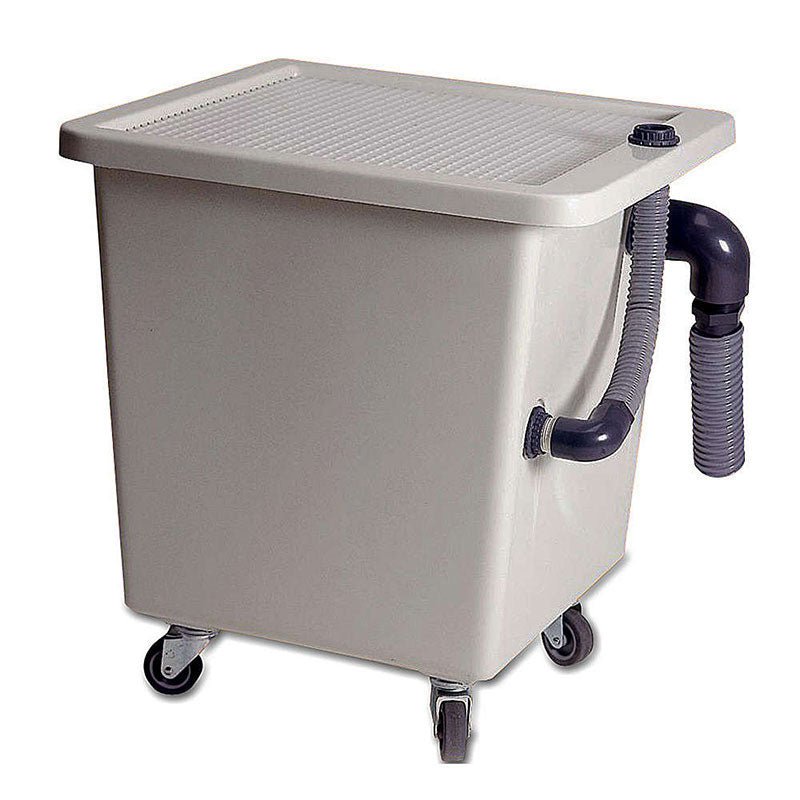


Mestra 70 L Settling Tank with Wheels & Breaker Grid
Earn 1 loyalty points
Référence: 080089
Why choose the Mestra 70 L decantation tank?
Designed for dental laboratories, this tank efficiently separates heavy particles and limits clogging. The breaking grid promotes fine particle agglomeration. The casters and easy tank access make maintenance fast and clean.
Instructions for use (summary)
- Install under the sink (check available height): inlet from sink outlet, tank outlet to main drain (Ø 50 mm, adapt if required).
- Position the breaking grid, check sealing and drainage slope.
- Carry out draining via the dedicated hose, with easy movement thanks to the casters.
- Periodic cleaning: remove the grid and sediment; recommended frequency every 2–3 months depending on use.
Please refer to the Mestra user manual for detailed steps, diagrams and safety instructions.
Technical specifications
| Capacity | 70 L |
|---|---|
| Dimensions | Height 615 mm • Width 520 mm • Depth 600 mm |
| Weight | ≈ 10 kg |
| Connection | Drain outlet Ø 50 mm (adapt to installation if required) |
| Tank material | Polypropylene |
| Equipment | Breaking grid + casters + connectors and accessories |
| Brand | Mestra |
| Reference / SKU | 080089 |
Recommended related products


Documents & resources
- Mestra user manual (PDF)
- Spare parts (PDF)
- Alternative: Mestra 19 L decantation tank • Mestra 14 L decantation tank
FAQ — frequently asked questions
Where should the tank be installed?
The tank is installed under the sink if sufficient height is available.
It is connected between the sink outlet and the main drain line.
Check the available height of 615 mm under the worktop.
Verify compatibility with the Ø 50 mm drain outlet.
Ensure access remains possible for draining and cleaning.
How often should it be cleaned?
The frequency depends on the volume of plaster and sludge generated by the laboratory.
Regular inspection helps prevent excessive sediment build-up.
In practice, cleaning every 2 to 3 months is recommended.
It is best to clean before the level reaches the connectors.
This routine limits odors and extends the system’s service life.
Is a flocculant useful?
Yes, a flocculant significantly improves fine particle decantation.
Particles group into heavier flocs and settle more quickly.
The tank stays cleaner and drain lines clog less.
Odors from suspended matter are also reduced.
Always follow the manufacturer’s instructions and recommended dosage.
 Mestra 70 L Settling Tank with Wheels & Breaker Grid